


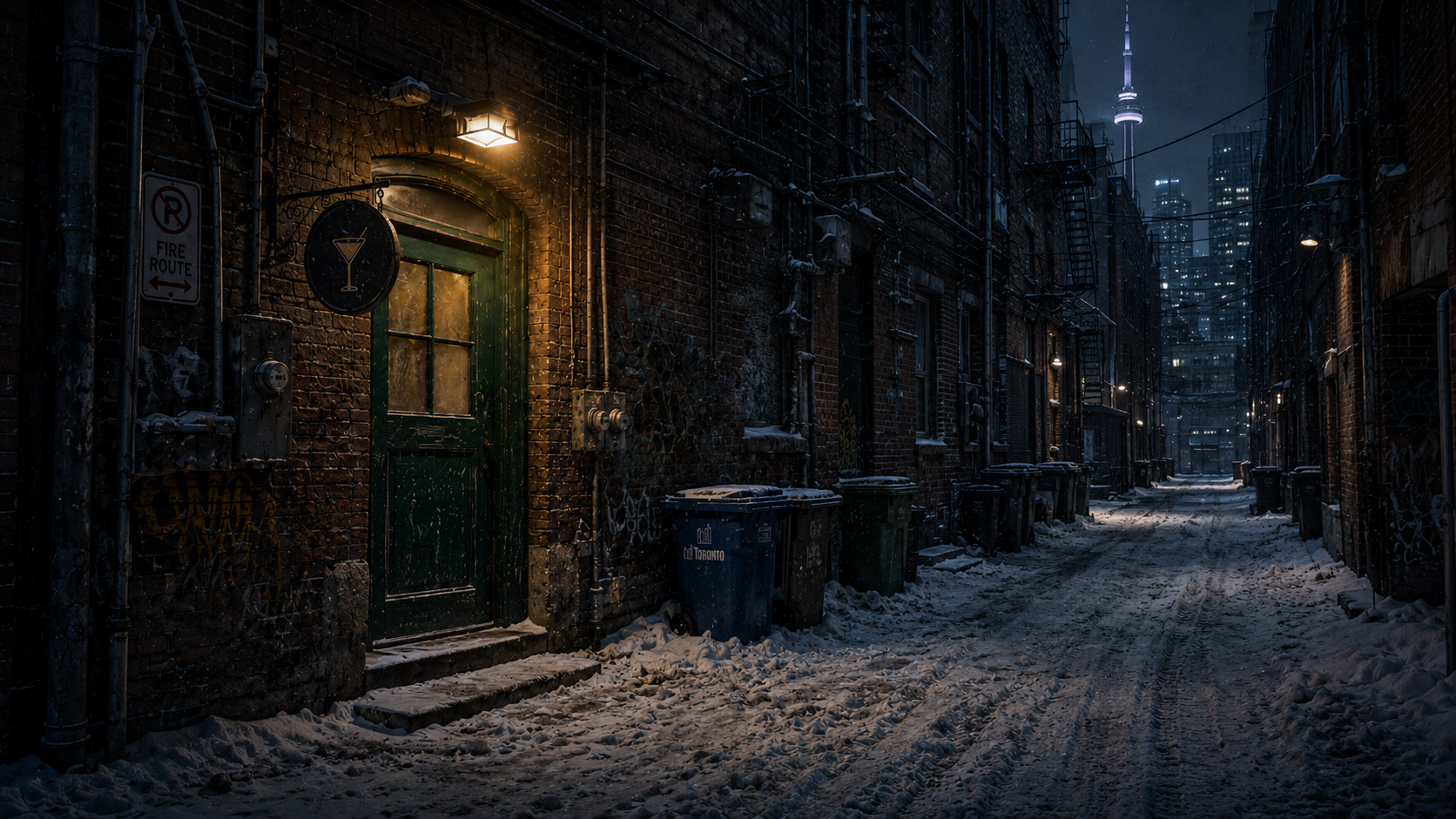
I don’t remember whose idea it was to get a drink.
I remember the cold. It had been snowing since lunch, and by evening the city had turned grey at the edges. Slush gathered at the curbs. Streetcars dragged themselves along frozen tracks. Mark and I had spent twelve hours in the office changing the wording on a presentation no one would remember by spring, and neither of us was ready to go home and admit the next morning was already waiting.
Every bar we knew was crowded, closing, or loud enough to make conversation pointless. We wandered west without much of a plan until Mark stopped at the mouth of an alley.
“Was that always there?”
Halfway down, beneath an amber lamp, a wooden sign swung from two rusted chains. It carried no name, only the outline of a drinking glass and an arrow pointing toward the first door on the left.
“I’ve worked around here for six years,” I said.
“Maybe you never looked.”
The alley was narrow but clean, its brick walls broken by fire escapes, delivery doors, and one green entrance with cracked paint. Warm light showed around the frame.
Mark studied it.
“If we get murdered, I’m haunting you.”
He pushed the door open.
The room beyond was smaller than I expected. A dark wooden bar ran along one wall, its brass foot rail polished bright where thousands of shoes had rested. Behind it, bottles crowded beneath a mirror cracked neatly through one corner. Water rings marked the counter. A dartboard hung near the washrooms without a single hole in it. Beside the entrance, a coat rack held three scarves, a bent umbrella, and an old brown coat that no one ever seemed to claim.
A radio played a song I hadn’t heard since junior high.
The woman behind the bar looked up.
“There you are, you're just in time.” she said.
Mark glanced over his shoulder.
“I think you have us confused with somebody.”
“It happens.”
She looked somewhere between thirty-five and forty-five, depending on the light. Her dark hair was tied back with a pencil, and she wore the black shirt and apron of someone who had long ago accepted that neither would stay clean.
“What are you having?”
“Whisky, neat” I said, weary from the long day.
She set down two heavy glasses and poured from a bottle whose label had worn nearly blank.
“If you hate it, I’ll pour something else.”
The whisky tasted of smoke, orange peel, and something I could not place. It reminded me of a seaside town I had yet to step foot io.
Mark took a second sip.
“I don’t normally like whisky, but this feels right.”
There were seven other people in the room. Three occupied a booth beneath the window. A man in a pea coat read a newspaper at the far end of the bar. Another peeled the label from his beer in narrow, perfect strips. A silver-haired woman kept stealing olives from the glass of the man beside her, who pretended not to notice.
They were discussing whether it was possible to forgive someone without wanting them back in your life.
“It has to be,” said the woman with the olives. “Otherwise, forgiveness is just poor judgment.”
The man beside her lifted his empty cocktail pick.
“You took the last one.”
“You weren’t eating it.”
“I was saving it.”
“For what?”
He considered this, furrowed his brow and sat back, resigned.
The bartender introduced herself as Nora. Or perhaps someone else called her that and we followed their example. By our second drink, Mark was arguing that Die Hard was obviously a Christmas film. The label-peeler disagreed on the grounds that a Christmas film required “a meaningful intervention by Christmas,” which led to fifteen minutes of debate over whether broken glass and machine guns counted.
At some point Mark began talking about his father. Not the office version, polished down to a few safe details, but the man himself: proud, silent, always working, capable of rebuilding a deck but not of saying he was sorry.
“I don’t know why I’m telling you this,” Mark said.
The man in the pea coat folded his newspaper.
“Most people tell strangers the truth,” he said. “It’s friends they lie to.”
No one laughed, though it was not said sadly.
When we stood to leave, Nora waved from the taps.
“See you next Thursday.”
“We’ll see,” I said.
She smiled, "You will."
Outside, the cold felt harsher than before. Mark and I walked two blocks without speaking.
Then he said, “Same time next week?”
The next Thursday, neither of us needed to ask. We passed the coffee shop with the broken espresso machine, crossed behind the old garment building, and turned down the alley. First door on the left. Someone had saved us two seats at the bar.
That was how it began.
The woman who stole olives was Evelyn. She had spent thirty years managing people and still believed most problems could be solved by asking one question and waiting long enough for the honest answer. Graham sat beside her. He added an unnecessary second ending to every joke and had once walked away from the woman he intended to marry because he was certain life would offer him the choice again. The man who peeled labels from his beer was Isaac. He maintained that every generation thought it had invented loneliness.
“They also think they invented the best music,” he said. “That is less forgivable.”
Most nights, we talked about nothing important. Landlords. Bad dates. Airline food. Why every office had one person who reheated fish.
Nora described the men she met online with the weary precision of a field biologist.
“How was the firefighter?” Evelyn asked one evening.
“Married.”
“To someone else?”
“One would hope.”
“And the architect?”
“Not an architect.”
“What was he?”
“Confident.”
On quieter nights, the conversations went deeper without warning. A discussion about old restaurants became an argument over whether places mattered after the people inside them were gone. A story about a missed train became a confession about a wedding someone had nearly stopped. No one announced when the subject changed. It simply did.
Nobody interrupted. Nobody checked the time. Phones appeared rarely and seemed embarrassed when they did.
The bar became where we went after work. If the day had been bad, Nora poured heavily. If it had been good, she poured heavily for a different reason.
One Thursday in late February, nothing unusual happened.
That was the night I loved most.
Graham arrived wearing two different gloves and insisted they were a pair because both were black. Evelyn spent half the evening trying to teach Mark a card game and the other half accusing him of cheating. Isaac put three dollars into the jukebox and chose the same song six times because he claimed repetition was the foundation of culture.
Someone knocked over a beer. Nora threw a towel at him without looking.
A man from the booth bought a round after learning that his daughter had been accepted into university. Nobody knew him well, but everyone cheered. He stood on the foot rail to make a speech, forgot what he meant to say, and raised his glass anyway.
“To doors,” he said.
“What kind?” Mark asked.
“The open kind.”
Isaac lifted his beer.
“Overrated. Drafty.”
Later, Fleetwood Mac came on the radio, and half the room sang badly. Nora sang loudest and denied it afterward. Evelyn danced with Graham between the tables, though neither of them knew the steps. Mark tried to pull me up from my stool, and I refused until Nora threatened to water down my whisky.
For three and a half minutes, we were all truly together in the moment.
When the song ended, everyone returned to their seats, laughing and breathless. The room smelled of spilled beer, wet wool, and the orange peel Nora had twisted over someone’s drink.
Outside, snow covered the alley.
Inside, we ordered another round.
Thursdays became seasons. We arrived in heavy coats and left beneath spring rain. The windows stood open in July, carrying in the smell of warm pavement. By October, Nora was making hot toddies again, and someone had put Fleetwood Mac back on the radio.
The city changed around us. The café on the corner became a pharmacy, then another café with different chairs and the same burnt espresso. Coworkers left. Towers climbed higher behind plywood walls. A restaurant we loved vanished over a weekend and returned as luxury condominiums a while later.
The first door on the left remained where we had left it.
We brought people from the office. Most enjoyed themselves. Few came twice.
“It’s too quiet,” one said.
“Nothing happens,” said another.
Mark and I laughed about that afterward.
Once, a man entered wearing a dark hat pulled low over one eye. Nora poured his drink before he removed his gloves.
He thanked her using a name I did not recognize. It was not Nora. The word was soft and old, its edges worn smooth by repetition.
The man drank alone. When he left, he placed three silver coins beside his glass. One showed a tree. Another showed a door. I reached for the third, but Nora covered it with her hand.
“Not yours,” she said.
“What country are they from?”
She swept the coins into her apron.
“Nowhere you can spend them.”
She asked whether I wanted another drink.
A woman in a charcoal coat came occasionally, accompanied by two enormous black dogs. They waited outside in snow and rain, watching the entrance without ever lying down. She ordered tea and spoke little. The room lowered its voice while she was there.
After one visit, I asked Evelyn whether she knew her.
“She helps people keep appointments.”
“What kind of appointments?”
“The ones they’ve delayed too long.”
Evelyn stole the olive from my drink and changed the subject.
There were other visitors. A pale man with beautiful hands who never removed his gloves. A laughing woman who wore an iron key around her neck. An elderly gentleman carrying a violin case he never opened.
They came alone, drank slowly, and left without anyone holding the door.
We noticed them but did not discuss them much. Curiosity felt impolite.
Time passed.
Mark missed a Thursday because his daughter had a school play. The next week, his husband had planned dinner. Then there was hockey practice, a vacation, overtime, a parent-teacher meeting.
At first, he apologized. Then he merely explained. Finally, he stopped doing either.
“You know how it is,” he said.
I did not, but I said I did.
I kept going.
Nora asked about him twice. Then she stopped. His stool remained empty for several weeks before a woman named Clara began using it. She had a laugh that shook the ice in everyone’s glasses and an ex-husband whose failures improved with every retelling.
One afternoon, Mark and I had lunch near the office. He spent ten minutes scrolling through photographs of his daughter in a school production, squinting at the screen because he refused to admit he needed glasses.
“We should go back to that bar,” he said.
“Thursday?”
He hesitated.
“Maybe.”
“You’re always busy Thursdays.”
“Am I?”
“You haven’t been in months.”
He looked surprised.
“Has it been that long?” He put his phone down. "What was the bartender's name again?"
“Nora.”
He smiled, but not with recognition.
“You know, I don’t think about that place much anymore.”
The server brought our food. Mark started talking about a camping trip his family was planning for the summer.
That evening, I went to the bar alone.
The regulars began disappearing too, though never all at once.
Graham stopped coming first. The last night I saw him, he told a story about missing a ferry when he was nineteen. It had changed the course of his life, though he had spent decades insisting it had ruined it.
“Same thing, sometimes,” Isaac said.
Graham laughed, “No. Not the same thing at all.”
He left before closing. Nobody said goodbye. Evelyn only touched his arm as he passed.
The following week his stool was empty.
“Where’s Graham?” I asked.
Nora wiped down the counter.
“Gone on.”
“Where?”
She looked at me the same way you look at a child when they ask why the sky is blue.
Evelyn disappeared near Christmas. Isaac remained a little longer. One night he peeled the label from his bottle, smoothed it flat on the bar, and handed it to me.
“For your collection.”
“I don’t have a collection.”
“You will.”
I slipped it into my coat pocket.
I never saw him again.
Other people filled the seats. New voices took up old arguments. A man named Peter declared that regret was vanity because it assumed we could have known better. A schoolteacher disagreed so fiercely that Nora had to remind her not to point with a cocktail fork.
The conversations always found their way backward.
People spoke about childhood homes, ruined friendships, first loves, old jobs, fathers, daughters, roads not taken. Even the jokes were about things long past.
I stopped mentioning work projects that had not started yet. I stopped talking about trips I might take. When someone asked what I was doing on the weekend, I said, “Nothing much,” before checking whether that was true.
Thursday required no planning. Thursday had already been decided.
One winter evening, after a day I could no longer distinguish from the days around it, I walked down the alley alone. Snow fell in loose, wet clumps, disappearing as soon as it touched the pavement.
The green door opened beneath my hand.
Inside, the regular stools were empty.
A young couple whispered in the booth. Someone slept beneath the old brown coat by the entrance. Nora leaned against the far end of the bar, swiping through profiles on her phone.
“Slow night?” I asked.
“They happen.”
She poured my usual.
An old woman sat three stools down.
She wore a dark wool coat buttoned to the throat. Her white hair was pinned carelessly at the back of her head, and both hands rested around a cup of tea that had stopped steaming. There was nothing imposing about her. Still, the empty stools on either side seemed deliberate.
I took one of them, and she turned to me.
“Why are you here?”
“For a drink.”
“That's not it.”
Her voice was gentle.
I glanced at Nora. She had returned to her phone.
“I like it here.”
“Most do.”
I watched her lift the cup. She did not drink.
“What do you mean?”
She looked at the door.
“When was the last time you made a plan for next Thursday?”
“I make plans.”
“For next Thursday?”
I opened my mouth, but nothing came.
The old woman nodded as though I had answered. The radio changed songs. I knew this one too.
“What is this place?”
She traced one finger around the rim of her cup.
“You know where you are, the first door on the left. Why ask?"
I looked toward Nora, but she was speaking to the young couple now. The man was crying quietly into his hands while the woman rubbed his back. I looked around the room. The cracked mirror. The coat no one claimed. The dartboard without holes. Water rings layered over older water rings.
Something about the answer irritated me.
“You’re being deliberately vague.”
“I’m old. People mistake that for wisdom, and wisdom for explanations.”
“Who are you?”
She smiled into her tea, "I've answered to many things."
“Such as?”
“Usually whatever someone needed.”
I looked down at my whisky.
“What did you leave outside?” she asked.
“My coat’s here.”
“No.”
“My phone?”
“No.”
“I don’t know.”
“That may be the trouble.”
She turned her cup once between her hands.
“Do you know what I like about doors?" She paused as I looked towards the green entrance. "They only work if someone walks through them.”
Suddenly, the taproom seemed a little colder, and the air stale.
“What are you saying?”
“I can't tell you what to do, that's not my place.”
“You’ve implied it.”
“People hear instructions when they are afraid of making choices.”
Behind the bar, Nora opened a bottle. The cap struck the floor and rolled beneath a stool. The old woman followed it with her eyes.
“Would you like to stay?”
The question caught me off guard.
“I don’t know.”
“You’ve been answering that very question every Thursday now for how long?”
The room dropped another degree.
I thought of Mark scrolling through photographs of his daughter. Graham leaving before his story became about the bar. Isaac smoothing the label flat and giving it to me.
I remembered the night everyone sang badly. Evelyn dancing between the tables. Nora throwing a towel at the man who spilled his beer. For three and a half minutes, no one had been lonely.
I wanted that night again, not one like it, that one. The old woman watched me.
“It was good here,” I said.
“Yes.”
“That matters.”
“It does.”
“Then why does it feel like you’re telling me it didn’t?”
“I would never say that.”
She glanced around the room.
“A chair can save a person who needs to rest.”
Her eyes returned to mine.
“It can do something else to a person who forgets to stand.”
Nora set another whisky beside my first.
“I didn’t order that.”
“You usually do.”
I looked at the two glasses.
One nearly empty. One full.
The old woman reached into her coat and placed a small brass key on the counter. It was plain and worn smooth, the sort of key that belonged to a lock long since removed.
“What does it open?” I asked.
“I don’t know, it isn't my key.""
“Then whose is it?”
She pushed it toward me.
I picked it up. The metal was warm. Nora called my name from the other end of the bar. When I looked toward her, she was holding up my scarf.
“You dropped this.”
I hadn't realized my scarf had left my neck. Nora shrugged. When I turned back, the old woman’s stool was empty. Her tea remained on the counter. No door had opened. No footsteps had crossed the floor. The surface of the tea was still.
I looked beneath the bar as if she might have dropped something. Nora collected the cup.
“Who was she?”
“You talked to her?”
“For twenty minutes.”
“How did it go?”
“It was unsettling. I still don’t know who she was.”
Nora glanced at the cup.
“I've only seen her a handful of times. It's strange... After she leaves, I have trouble remembering our conversations. Little details seem to fade quickly."
I left cash beneath my glass. Nora pushed the loose bills back.
“You’ve paid enough.”
I put on my coat and picked up my briefcase. At the entrance, my hand settled on the brass handle.
Someone behind me began telling a story. I recognized the opening. Graham had told it once, though this man used a different city and gave the woman another name.
The room was warm. The radio was playing another song from school. My second whisky waited untouched on the bar.
I could sit down for one more. Hear the ending. Come back next Thursday.
The thought felt so harmless that I understood, finally, how people stayed forever.
Nora polished a glass.
“The living always think they’ll miss this place,” she said.
I looked back.
“Won’t I?”
“Sometimes, when the road ahead seems longer than the one behind you.”
I opened the door.
Snow struck my face. The alley was colder than I remembered, loud with traffic and a distant siren. I took several steps before turning around.
There was no green door.
The brick wall ran unbroken from one end of the alley to the other. No frame. No light. No sign above it.
I walked the length of the wall twice, pressing my palm against the frozen bricks. A man passing with a dog slowed to watch me.
“You lose something?”
“There was something here. No mind.”
The dog pulled him onward.
I stood in the snow with the brass key in my pocket and tried to remember the name of the place.
I had never known it.
Life resumed before I was ready.
There were early mornings, deadlines, promotions, illnesses, funerals, weddings, failures, and small kindnesses I would once have been too tired to notice. Friends disappeared into children and mortgages, then returned older and more themselves. New people arrived. Some stayed. Others were only passing through.
For the first few months, Thursday evenings felt wrong.
I would leave work and walk several blocks west before remembering there was nowhere to go. Once, I found myself standing at the mouth of the alley without knowing how I had arrived there.
The wall remained.
Eventually, Thursdays became available again.
At first I wasted them. Then I accepted a dinner invitation. Joined a friend at a gallery. Took a train out of the city for no particular reason. None of those evenings became sacred. Most were ordinary. That seemed important.
Mark and I had lunch years later.
His daughter was applying to university. His hair had gone grey at the temples, and he complained about his knees. Halfway through the meal, he asked whether I remembered the little bar we used to visit after work.
“The one down the alley,” I said.
He frowned.
“What alley?”
“The place with Nora.”
“Who?”
I looked at him. For a moment I thought he was joking.
Then the server arrived with our coffees, and Mark began telling me about his daughter’s plans to study abroad. He and his husband were worried about the cost, but proud of her for going.
The brass key remained in my desk for years. It opened nothing I owned. Eventually, I began carrying it in my coat pocket every winter, though I could not have explained why.
Sometimes, after a bad day, I still look down unfamiliar alleys.
I look when grief has made the road ahead seem longer than the one behind. I look when the city has changed too quickly, when old songs come on the radio, or when I find myself telling the same story for the third time and improving none of it.
I have never found the first door on the left again.
But when there are no roads left to take, I hope the old coat is still hanging by the entrance. I hope Nora is behind the bar, pretending not to remember me. I hope Evelyn has stolen Graham’s olive, and Isaac is peeling the label from his beer.
Most of all, I hope the light is on.
And that when I open the door, someone looks up and says, with no surprise at all:
“There you are. You’re just in time.”

Travel

Travel

Life's too short for titles
I'm quite certain the world is conspiring to make me happy.